Advanced Orthopaedic Care & Compassionate Healthcare
Gayatri Hospital is built on a strong foundation of trust, ethics, and compassionate healthcare, serving the community since 1995. Our specialized departments work together to support the health and well-being of our patients.
Open Monday to Sunday, 24 Hours
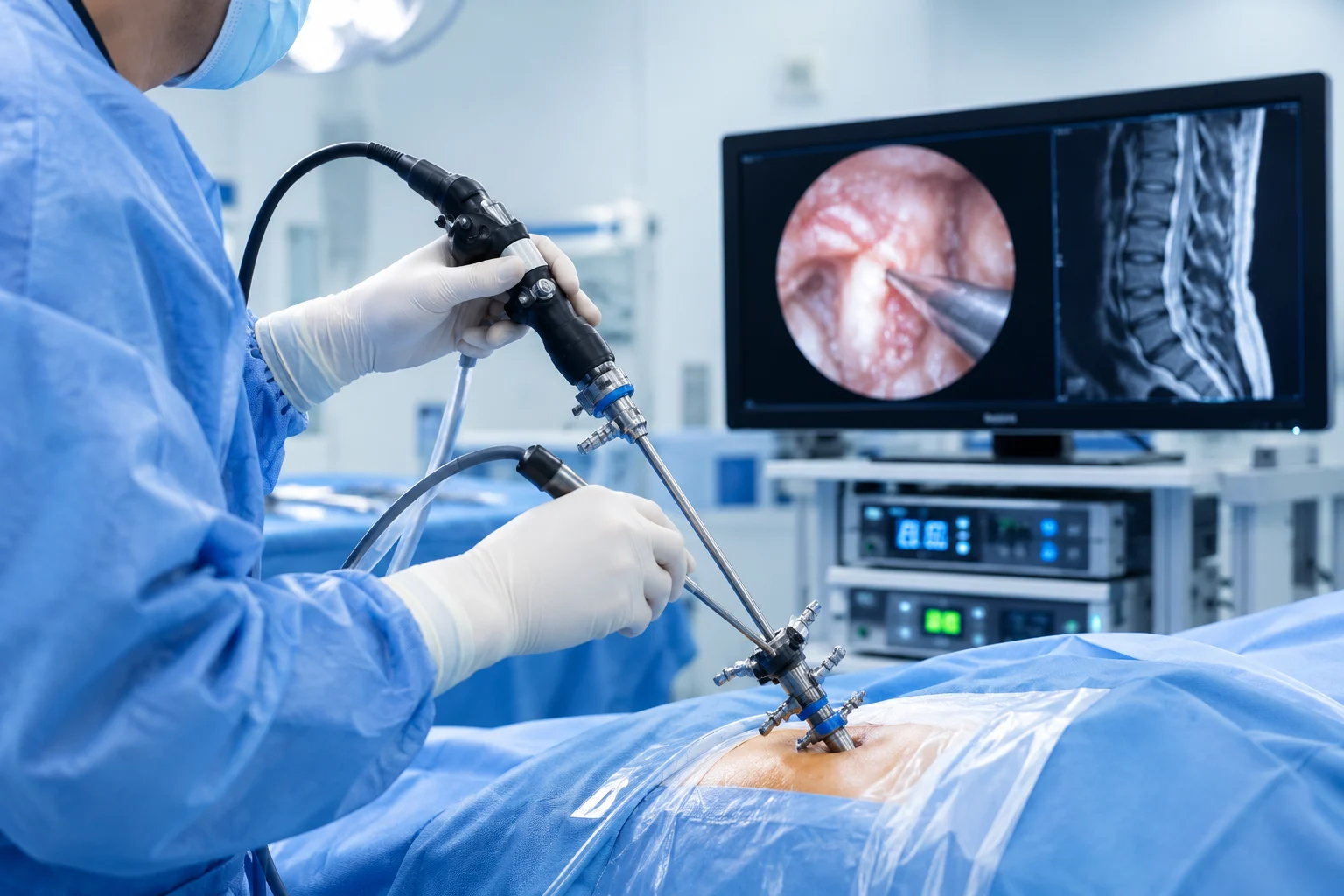
Book Your Appointment →Endoscopic spine surgery is a minimally invasive technique used to treat selected spinal conditions through a small incision with the help of specialized instruments and an endoscopic camera. It is sometimes called keyhole spine surgery because it generally uses a smaller surgical access point than conventional open surgery.
Potential benefits of minimally invasive spine surgery for appropriately selected patients.

Endoscopic spine surgery uses a small incision, specialized instruments and an endoscopic camera to access and treat selected spinal problems.
It is not suitable for every spine condition. A spine specialist considers the diagnosis, imaging findings, symptoms and overall health before recommending the appropriate approach.
Suitability depends on the patient’s diagnosis and individual clinical findings.
Suitability depends on clinical assessment
For appropriately selected patients, minimally invasive techniques may offer certain advantages compared with conventional open surgery.
Outcomes vary depending on the condition, procedure and individual patient. These potential advantages cannot be guaranteed for every person.
Suitability depends on the patient’s diagnosis and individual clinical findings.
No. A spine specialist should assess the patient’s condition before deciding whether endoscopic, conventional or non-surgical treatment is appropriate.
Suitability depends on clinical assessment
For appropriately selected patients, minimally invasive techniques may offer certain advantages compared with conventional open surgery.
Outcomes vary depending on the condition, procedure and individual patient. These potential advantages cannot be guaranteed for every person.
No. A spine specialist should assess the patient’s condition before deciding whether endoscopic, conventional or non-surgical treatment is appropriate.
A specialist reviews the diagnosis, symptoms, imaging findings and overall health to help determine the most appropriate treatment option for the patient.
Understand the specific spinal condition being evaluated.
Review relevant scans and the location of the problem.
Consider endoscopic, conventional or non-surgical approaches.
Consider individual health and other clinical factors.
Speak with a spine specialist to understand whether endoscopic spine treatment may be suitable for your condition.

A specialist reviews the diagnosis, symptoms, imaging findings and overall health to help determine the most appropriate treatment option for the patient.
Understand the specific spinal condition being evaluated.
Review relevant scans and the location of the problem.
Consider endoscopic, conventional or non-surgical approaches.
Consider individual health and other clinical factors.
Speak with a spine specialist to understand whether endoscopic spine treatment may be suitable for your condition.

© 2026, Gayatri Hospital, All rights reserved || Designed By Digital Amigos